
 Posted by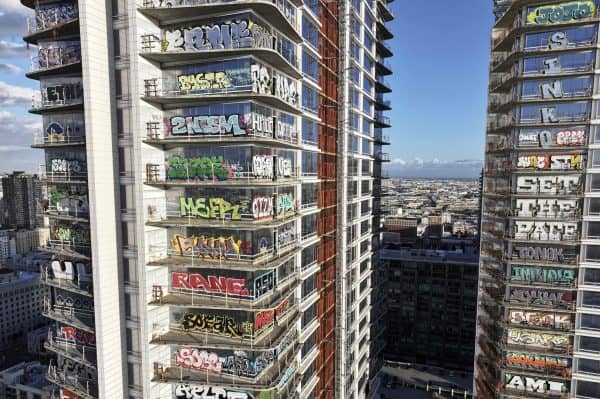
Los Angeles’ long stalled Oceanwide Plaza project, the $1.2 billion development downtown that’s been nicknamed the “Graffiti Towers,” has reportedly reached a bankruptcy exit agreement with creditors, setting the stage for a potential sale and renewed movement toward completion ahead of the 2028 Olympics.
The massive complex has been frozen since 2018, when the project’s Chinese developer, China Oceanwide, ran out of funding after Beijing tightened restrictions on overseas investment. Since then, the unfinished towers have become a cultural talking point not only because of the money tied up in them, but because the exposed structure turned into a towering canvas for graffiti writers. What city leaders and downtown boosters often describe as a sign of decay has also been viewed by many as proof of what graffiti culture always does best: take what’s abandoned and give it voice.
The bankruptcy exit settlement resolves an internal creditor dispute and could clear the way for a deal with a potential buyer already in talks, according to people familiar with the discussions. From a legal standpoint, Oceanwide’s attorneys framed the settlement as a practical pivot away from costly courtroom battles and toward a sale.
In a January 28 court filing, lawyers for Oceanwide wrote, “A prompt sale and eventual completion of the project is a major priority for the city and the public at large, particularly with the upcoming 2028 Olympic Games in Los Angeles.” They also noted, “The city fully supports the approval of the settlement agreement.”
They added that the agreement is meant to stop ongoing damage to the project’s value caused by drawn out litigation. In the same filing, Oceanwide’s lawyers wrote, “The settlement agreement puts an immediate stop of this value destructive litigation,” and said it would help preserve assets and shift focus back to selling the project and confirming a plan.
Even with the legal logjam easing, the big questions remain. The towers are still only partially enclosed, leaving concrete and steel exposed to rain and long term wear. Completion costs, timelines, and the scale of rehabilitation are still unknown. The project has also carried years of unpaid property taxes and major creditor claims. Under the agreement, lender group LA Development Investment LP would be entitled to a $230 million claim, with other creditors holding hundreds of millions more.
But whatever happens next, the graffiti era of these towers is already part of Los Angeles history. In a city where street art has always been both resistance and documentation, the “Graffiti Towers” became an accidental monument to writers doing what they’ve done for generations: marking time, claiming space, and speaking for communities that glossy development plans tend to overlook.
If the project gets sold and rebuilt, the art likely won’t survive in its current form. But its impact will. Whether the city admits it or not, those walls carried a living archive of LA’s creative spirit, and that deserves to be recognized, not erased from the story.